
Wheel Variance and Its Role in Determining Promotional Clearance Efficiency for Roulette Players
Data from multiple regulated markets indicates that wheel variance directly influences the speed at which players complete wagering requirements attached to promotional offers in roulette environments, and this connection emerges because higher variance produces larger outcome swings that either accelerate or delay the accumulation of required playthrough volume.
Defining Wheel Variance in Digital Roulette Contexts
Wheel variance measures the statistical spread of results around the expected return percentage on any given spin, and European-style wheels with a single zero generate lower variance compared to American configurations that include both a zero and double zero, while platform algorithms further adjust this spread through random number generation parameters that operators set to meet jurisdictional standards.
Studies conducted by academic researchers at institutions focused on probability mathematics show that variance levels affect session volatility, and players encounter longer losing streaks on high-variance wheels even when the house edge remains constant across variants.
Promotional Clearing Mechanisms and Variance Interaction
Promotional offers typically require players to wager a multiple of the bonus amount before withdrawal eligibility activates, and clearance rates depend on the volume of bets placed rather than net wins or losses, yet variance still plays a measurable role because extreme swings can trigger responsible gaming limits or prompt players to adjust bet sizes mid-session.
Platform operators track clearance progress through internal systems that log every spin against the requirement threshold, and data indicates that sessions on lower-variance wheels produce more consistent progress toward completion while high-variance setups create uneven pacing marked by sudden jumps or prolonged plateaus.
Platform Variants and Regional Regulatory Influences
European operators licensed under frameworks such as the Malta Gaming Authority maintain wheel configurations that often favor single-zero designs, and these choices correlate with steadier clearance patterns observed across player cohorts, whereas North American platforms regulated by bodies like the Nevada Gaming Control Board frequently offer both wheel types and record differentiated clearance timelines accordingly.
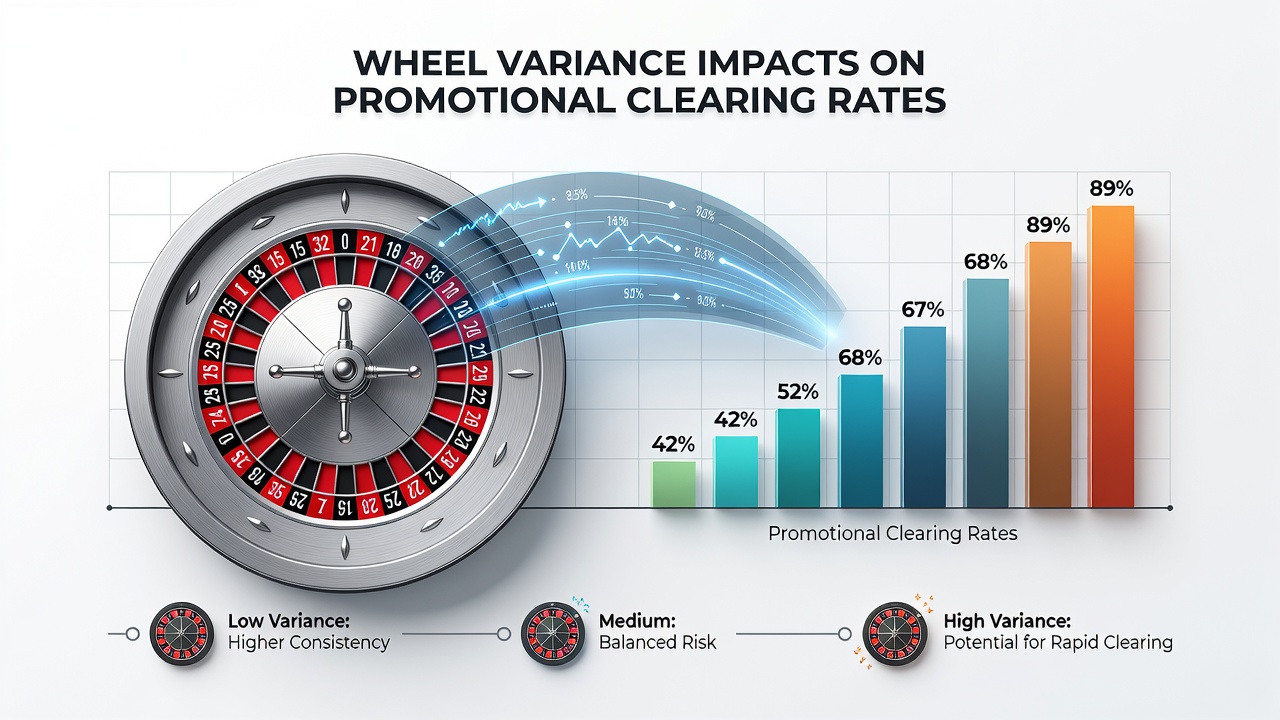
September 2026 figures compiled by industry monitoring groups reveal that platforms offering configurable variance settings saw clearance completion rates vary by up to eighteen percent depending on the wheel selected during bonus activation periods, and this spread widened further when players combined multiple sequential offers.
Quantitative Patterns Across Player Sessions
Research reports from university-affiliated gambling studies programs demonstrate that sessions lasting under thirty minutes on high-variance wheels clear an average of twelve percent less of the required wagering threshold than equivalent sessions on low-variance wheels, while longer sessions exceeding ninety minutes narrow this gap because variance effects average out over greater spin counts.
Operators adjust bonus structures in response to these observed patterns, and some introduce wheel-selection prompts that inform players of variance implications without altering the underlying mathematical requirements.
Conclusion
Available evidence establishes a clear statistical relationship between wheel variance and promotional clearance timelines across roulette platforms, and regulatory bodies continue to monitor these dynamics to ensure transparency in how game parameters interact with offer conditions in digital environments.